Showing posts with label Lessons. Show all posts

Wednesday, April 22, 2015

Lego, Math and Real-Life Problem Solving

Twitter has been abuzz  (atweet?) lately with some amazing math lessons, using real costs for Lego.

Mr. Orr is a Geek.com  wrote an incredible blog post about whether or not Lego-pricing is gender-biased.  Check it out!

Anyhow, I digress, and so on to my story...

The other morning, while drinking my coffee at home, I received a sale notice in my inbox from a toy store that I frequent often: Mastermind Toys.  Since shopping, and my kids, are two things that I love dearly (ok, my children come out WAY ahead of shopping), I went in for a little look.

They are ages 6 and 8, and they are into the "Lego-years" now, so one of my plans is to build them a Lego wall at our camp, for those rainy, summer days.  I have been stalking Lego baseplates, and noting they are very expensive, so I always take a look whenever I am online.

Sand Baseplate

Grey Baseplate


The conversation that ensued was likely the most lively mental math discussion we ever had in class. Students were determined to give me advice on the better deal.

No, it wasn't a typical "number strings" mental math lesson. Did it get the students thinking? Were they using mental math skills? Yes to both.

Do you know which is the better deal?
(And, incidentally, do you know of a better price for Lego Baseplates within Canada???? I really am looking for some.)

Friday, April 3, 2015

Fractions, baking and lowest terms: real-world math

I think that the hardest thing I have encountered in math this year is trying to instil in students the importance of understanding math, not just memorizing rules.  So many times I hear..."I remember doing this last year, but I can't remember the rule".

My message is that if you understand the "why", then there are many different ways of "how" to do it. No rules needed.

Except maybe one.  Lowest terms. ;-)

I decided we would bake.  Cooking is something I try to do several times a year with my classes.  It's engaging, it's a life skill, and it's FUN. Besides, it was the day before Easter Break so baking Bunny Bread was the perfect activity.

I gave students a Bread-in-a-bag recipe. I changed the measurements so that they had to calculate the actual amounts.

Bread in a Bag Recipe
Directions
In a one-gallon (heavy-duty) Ziploc bag, mix:

½ X 6/6  cup all purpose flour

9/4  teaspoons yeast

¼ + 2/8  cup warm water

⅓ X 6 tablespoons sugar

Close the bag and knead it with fingers until the ingredients are completely blended. Leave the bag closed, with the contents in the corner, and let rest 10 minutes. You can eliminate this wait by using instant yeast.

Then add:

⅓ x 12/2 cups whole wheat flour

¼ x 2 5/5  cup warm water

5/5  tablespoon vegetable oil

1 1/10 + 18/20 teaspoons salt

Mix well. Add enough all-purpose flour to make a stiff dough, about 1 or 1-1/2 cups. Close the bag and knead it (you may need to remove some air in the bag.) Add more flour until dough no longer sticks to the bag. Spray the hands or food handlers gloves with oil so there will be no sticking. Open the bag and allow the dough to fall out onto clean or gloved hands. Form the dough into a loaf, and place in a loaf pan or onto a cafeteria cookie sheet. Remember the dough will grow 1-1/2 times larger, so leave space between loaves if baking on a cookie sheet. Cover the loaves with oil sprayed plastic wrap and allow to rise 30 (quick rise yeast) to 45 minutes. Bake for 30-35 minutes in a 350 degree oven. Now that’s real world science!  

When they completed the calculations, they began to make the recipe.

EXCEPT, as some discovered, measuring cups don't come in 12th's, nor do measuring spoons have 20th's marked on them.

They noticed that they had to make their answers mixed numbers and lowest terms.

They had a real-world reason to use fractions and to make their answers in lowest terms.

An unexpected spin-off was the mini-inquiry about yeast that the students engaged in. "What is yeast? What does it do? Is it really alive?"

They discovered, by researching while waiting for their yeast to proof, that it is a living organism, and that it requires sugars and heat to grow.  All on their own.

Best of all? They got to eat the results. Bunny bread success!
Ready for the oven.
Baked and ready to eat.


Thursday, February 19, 2015

Grade 7/8 History Inquiry - Nailed It!

Trying to move toward inquiry is something that my students and I have all been struggling with. It is new to half of them (the students that were not with me last year), and something that I am still learning myself. There have definitely been some  many bumps along the way. So much so that I was considering moving away from open inquiry to very structured, guided inquiry with me providing the questions, resources and walking them through every step.

However, I have had a success. I gave it one last-ditch effort with my History curriculum, and somehow, made History matter.

I posed the following question to both grades:

What are the 10 most significant events in Canada's history during your time period?

That was it.

As a class, we created criteria for what made a historical event significant.

Then, I turned them loose.

Each group had to create a timeline of their ten events, and be able to back up their choices. They had to know the 5 w's and be prepared to answer questions from their classmates.

The day before they presented I was worried.  What if they didn't learn anything? What if they just regurgitated dates and places from Wikipedia? I knew that this wasn't entirely the case, as I had pages of anecdotals from listening in as they researched and debated within their groups, but had they retained anything?

Presentation day arrived. As each group got up to present, I became more and more blown away and amazed by what I was hearing.

Most groups prepared timelines using a variety of software - the favourite and most user-friendly was voted to be the ReadWriteThink Timeline generator. As each group presented, students added stickies to a paper timeline to compare and contrast the events each group chose.
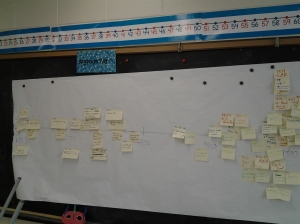
20150210_104143

They debated the merits of the choices of other groups. "Was the first gold rush or the biggest gold rush more significant?" They asked deep questions. "What would Canada be like today if the Metis had won the rebellion?" They challenged each other. "Are you sure that is the correct date?" They synthesized their learning. "I noticed that during the Grade 7 timeline (1713-1800) there were many wars and rebellions, then during the Grade 8 timeline (1850-1890) the key events were about Canada becoming a country."  They uncovered harsh realities that they knew nothing about. "Why did they have residential schools?" "I can't believe they lasted until 1996!" "This affected people living here? In our community?"

Historical thinking and inquiry. They nailed it!